What a Security License
Actually Proves.
Everyone puts one on the proposal. Almost nobody explains what it means, which is convenient, because what it means is narrower than it looks. Understanding it makes you considerably harder to sell to.
The short answer
The short answer
Florida security work is governed by Chapter 493 and licensed through the Florida Department of Agriculture and Consumer Services. Two separate licenses matter. The company holds an agency license, the Class B. The individual Officer holds a Class D for unarmed work, which follows a 40-hour state-approved course, plus a Class G in addition to it if they're armed. Managers hold a Class M or MB. Licenses renew every two years. A license number proves someone is legally eligible to work. It proves nothing at all about whether they're any good.
There Are Two Licenses,
and They Do Different Jobs.
When a provider says "we're licensed," the honest follow-up is "which one, and does the Officer standing on my property have theirs?" Those are not the same question, and a company can be entirely truthful about the first while the second is a mess.
The agency license
The company itself is licensed to provide security services in Florida. That's the Class B, and it's the number you'll see on a proposal. Ours is #B1900411.
It means the business exists legally and has been through the state's process. It says nothing about who they send, how they train, or whether anybody checks the post.
The individual license
The state licenses the person, not just the company. Each Officer holds their own, and it's theirs. They carry it, it renews on their clock, and misconduct is chargeable against them personally.
That's a bigger deal than it sounds.
Two licenses, and one of them travels with the person. Which means the classes are worth understanding.
Four Letters
That Do All the Work.
Florida's license classes look like alphabet soup and are actually simple. Only a handful of them come up in ordinary guard work.
| Class | Who holds it | What it covers |
|---|---|---|
| Class B | The company | The security agency license. What a firm needs to provide security services in Florida at all. |
| Class D | The Officer | Unarmed security work. Follows a 40-hour state-approved course. |
| Class G | The Officer, in addition to a D | Armed work. It is held on top of the Class D, never instead of it. |
| Class M / MB | Managers | Agency manager and branch manager. |
Governed by Chapter 493, Florida Statutes, and issued by the Florida Department of Agriculture and Consumer Services. Eligibility runs to being 18 or over, a US citizen or legal resident, a high school diploma or equivalent, a clean background check with fingerprinting, and completion of the required course. Licenses renew every two years. What the law says is one thing. What any specific situation requires is a question for the state or for your own counsel.
So a Class G Officer is a Class D Officer who also went and did the firearms license. Which quietly demolishes one of the most common assumptions in this industry.
Armed Is Not an Upgrade.
It's a Different Decision.
Because a Class G sits on top of a Class D, it is very easy to read the letters as a ladder, with armed at the top. It isn't a ladder. It's a different tool for a different risk, and it carries a different set of consequences.
It doesn't expand what an Officer may do
An Officer, armed or not, has the same authority to detain as any private citizen. Any use of force is governed by state law and limited to what is reasonable and necessary. The license changes the equipment, not the powers.
It doesn't mean better trained
A Class G is a firearms license. It is not a license in judgment, de-escalation, report writing, or knowing your building. Those come from the company, or they don't come at all.
The right question isn't "would armed feel safer?"
It's "what specific threat would an armed Officer address that a well-run unarmed operation could not?" A serious provider will tell you honestly which one your site needs, including when the answer is unarmed.
A license gets someone legally eligible to work. What happens on top of it is the entire difference between an eligible person and an effective one.
State Hours Are a Minimum,
Not a Ceiling.
Florida's 40-hour Class D course is a real bar and it does real work. What it cannot do is teach somebody your building, your residents, your vendors, or what to do when a contractor with no badge is standing at the loading dock at 6 a.m. saying he's expected.
Why the individual license changes the incentive
Because the state licenses the person, an Officer carries real personal exposure. Chapter 493 treats things like abandoning a post without relief, sleeping on duty, working under the influence, breaching confidentiality, or impersonating a law enforcement officer as license-level misconduct. Not a performance conversation. A license they may not get back. That is the standard every Officer is already working to, and it is a good reason to treat them as professionals rather than as bodies.
So the license tells you the floor. What tells you the rest is what a provider does when you ask about it.
Five Answers That Should
Slow You Right Down.
These come up more than they should. Not usually out of dishonesty, but because in an industry that competes on price, the license becomes the only credential left worth mentioning, so it gets asked to carry far more weight than it can hold.
The license is the easiest thing in this whole business to verify. Which is exactly why so much gets hidden behind it.
What People Ask
About the Paperwork.
How do I check a company's license?
Ask for the agency license number, and then verify it with the Florida Department of Agriculture and Consumer Services, which is the state body that issues them. A real provider will hand you the number without hesitating. Ours is #B1900411. If someone is slow to give you a number, that hesitation is the finding, not the number.
Does the Officer on my property need to carry their own license?
The state licenses individual Officers, not just companies, so each Officer holds their own. What's worth doing is asking a provider how they verify and track it, because renewals come around every two years and a lapsed license on your site is a problem you inherit without ever having been told about it. Ours is checked during the compliance phase of the startup, before anyone reaches the property.
How do I know the person on my site is actually who they say they are?
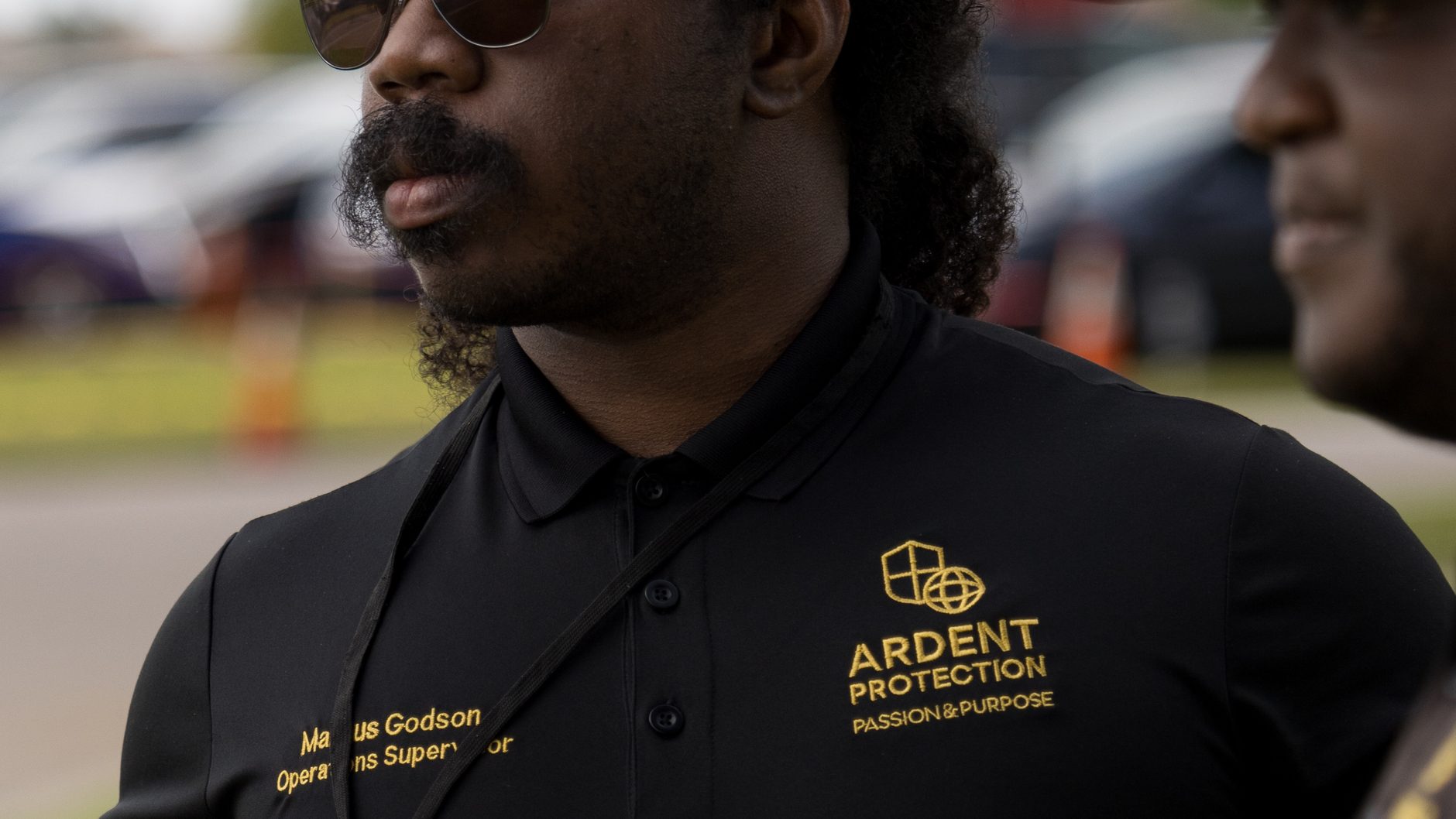
Every ARDENT Officer wears a uniform and carries an identification badge with a number you can verify by calling us directly. If you ever see someone claiming to represent ARDENT and something feels off, whether it's the wrong hours, the wrong uniform, or just a bad feeling, call us. We would rather answer ten calls that turn out to be nothing than have one impersonator go unreported.
I'm thinking about getting licensed myself. Where do I start?
The Class D is the usual entry point: a 40-hour state-approved course, a background check with fingerprinting, and an application through the Florida Department of Agriculture and Consumer Services. Eligibility runs to being 18 or over, a US citizen or legal resident, and holding a high school diploma or equivalent. If you're weighing it up as a career rather than a stopgap, our Careers page lays out what the job actually looks like, including the parts nobody mentions in a job ad.
The license is the beginning of the conversation. It is not, on any site anywhere, the end of it.
Written by the People
Who Hold the License.
ARDENT Protection
A Florida security and protection company, licensed since 2020, Florida Security Agency License #B1900411. We run Guard Services, Fire Watch, Event Security, Executive Protection and Workplace Violence Prevention across the state. Officer licensing and renewal are tracked by us as an operational responsibility, not left to the Officer to remember. Questions about anything here go to (954) 787-3700, and a person answers. Anything touching your own legal obligations is worth putting to your own counsel rather than to a security company.
What to Expect From a Professional Guard Service
Everything that sits on top of the license, which is where the entire difference actually lives.
Read itManaged or Just Placed: The Line That Decides Everything
Two licensed companies. Same paperwork. Completely different night when something goes wrong.
Read itWho Actually Checks On Your Security Officer?
The license gets someone onto your property. This is what keeps the standard from sliding once they're there.
Read itNone of this needs deciding this week. Reading first is a perfectly good way to start.
Ask Us for the Number.
And then ask everyone else you're considering. Tell us what you're protecting and we'll give you a straight read on what it actually needs, including if that's less than you were told. Or call (954) 787-3700. Someone will pick up.