What Should Already Be Included,
Without You Having to Ask.
Most people never get to see what a well-run guard operation actually looks like, because nobody ever showed them one. So it's hard to know what's ordinary and what's a favor. Ordinary is a great deal more than most providers hand over.
The short answer
The short answer
A professional guard service should already include post orders written for your property, Officers who train before they stand a post, supervision that turns up unannounced, incident reports sent to you without being chased, a trained escalation ladder rather than an instinct, and a structured startup. None of that is an upgrade. If a provider presents any of it as an extra, they've just told you what's in the base package.
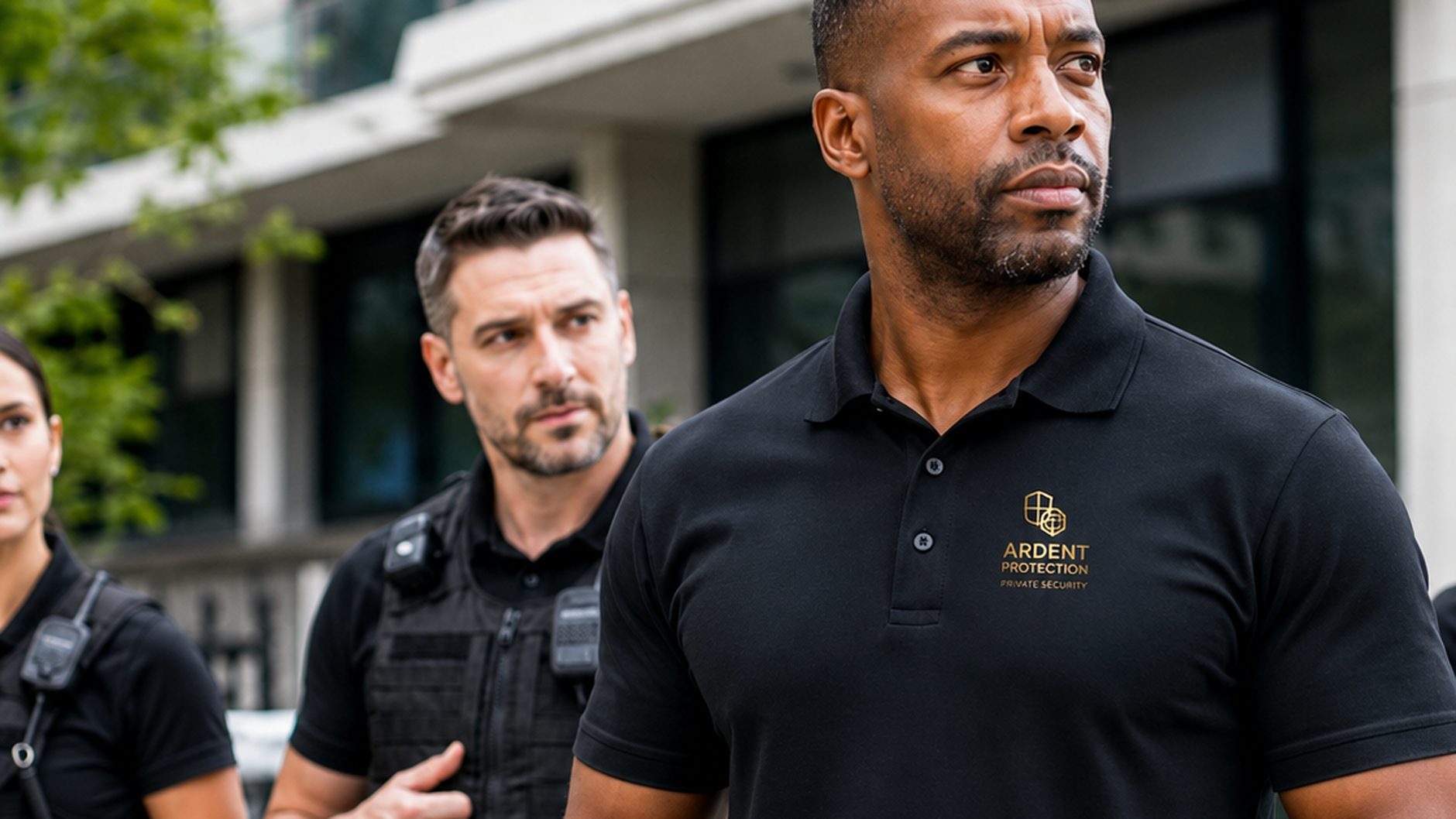
You're Not Really Buying
"a Guard."
You're buying coverage you can count on, Officers who make you look good, and a company that tells you the truth when something goes wrong. In practice, that comes down to a list. It's worth holding this up against every quote you get, including ours.
A list like that is easy for anyone to write down. What makes it true is everything that happens after the contract is signed.
Putting an Officer on a post is the easy part.
Everything that happens after is the job.
The ARDENT Operating Standard.
The ARDENT Operating Standard is the name we give to five things that happen around every Officer we place, on every site, whether it's two nights or five years. We're naming ours because you should be able to ask any provider for theirs.
Post Orders for Your Site
Written for your property, built with you during startup, and kept current as the site changes.
Trained, Vetted Officers
Every ARDENT Officer completes 16 hours of ARDENT training on top of Florida's required 40-hour Class D certification, before they ever stand a post.
ERT Site Checks
Scheduled and unannounced. An Officer from our Emergency Response Team, the standing bench we keep ready for urgent work, verifies the post against the orders and then tells you what they found.
Reporting You'll Read
Clear, concise, complete, accurate. Sent to you. Not filed somewhere for us.
A 30-Day Startup
Six defined phases, from assessment to first shift. A process, not a hope.
Most security problems aren't caused by a bad Officer. They're caused by a company that placed one and walked away.
Will an Officer Prevent Trouble,
or Start It?
If you've ever worried that a security presence creates a liability instead of preventing one, this is the thing standing between the two. Officers escalate through a four-step ladder. Most situations end on the first or second rung, which is exactly the point.
Presence
A visible, alert Officer, positioned to be seen. For most problems this is the entire solution. Nothing happens because somebody is clearly watching.
Notification
Informing someone of the site's rules. Respectful, non-confrontational, and usually enough.
Warning
Stating clearly what happens next if the behavior continues. Often the last chance for someone to walk it back on their own.
Enforcement
A documented incident report to your management. If it's criminal, law enforcement, and that is a last resort rather than a first instinct.
What a real report looks like
Our standard is clear, concise, complete and accurate. Complete means who, what, where, when, why and how. Accurate means factual, with no assumptions and no guessing at motive. Officers are trained that "Fire, Flood, or Blood" means notify immediately, and that when in doubt, you write the report. Every report is written knowing who eventually reads them: your management, law enforcement, and sometimes attorneys. A report written to make us look good is worthless to you, so we don't allow them.
All of that is what happens once coverage is running. Which leaves the part almost everyone is quietly dreading: the changeover itself.
Changing Security Companies
Shouldn't Become Another Project.
You already have a job. So our entire 30-day startup is written down, phase by phase, and almost all of it is our work rather than yours. Worth asking any provider to walk you through theirs at this level of detail before you sign.
Site visits and a real assessment. A transition team meeting. Recruitment begins immediately, not after the paperwork clears.
We review whatever program you have now, and where it makes sense, we retain select existing Officers who already know the property.
Post orders are developed with you, not handed to you. Resumes and references reviewed. Interviews run.
Pre-employment training. Final selection. Gear and uniform issued.
Background checks and licensing verification, confirmed before anyone reaches your property.
Site-specific training on your actual property. Leadership assigned. Then the first shift, with people who already know the site.
So what do you actually have to do?
It's the question that almost never gets a straight answer, and it's the reason people stay with a provider they've already given up on. Across all thirty days, your part is three things:
- One walkthrough. You show us the property.
- One post-orders session. We write them, you tell us what we got wrong. You know things about your property that we won't.
- One transition meeting. We meet your points of contact. Who to call, who to escalate to, what you never want to be surprised by.
That's it. The recruiting, the training, the background checks, the licensing and the scheduling are all ours. If switching feels like a second job, the provider is doing it wrong.
All thirty days run while your current coverage is still in place. Be careful with any provider whose answer needs you to go uncovered for a few days to make their scheduling easier.
The Things You Should
Never Have to Chase.
If any of these show up as line items, upgrades or favors, the base service is thinner than it looked. That isn't a moral failing on the provider's part. It's just what a price built without them looks like from the inside.
All of it is checkable before you sign. Which is a lot more than most people are ever offered.
Worth Asking Any Security Company.
Can I see a sample set of post orders before I sign?
Yes, and it's a fair thing to ask of any provider. Post orders are where the standard actually lives. If a company can't show you what they'd write for your site, or hands you a template with another client's name still in it, you've learned something important for free.
How often does a supervisor actually visit the post?
Regularly, and some of those visits are unannounced. What gets verified: the Officer is on post and in uniform, has current post orders and understands them, has a working radio or phone and the site contacts, is running the full patrol route, and is keeping the log current. Every visit is documented. Left unchecked, any standard drifts. Not because people are lazy, but because a skipped patrol on a quiet night is exactly how erosion starts. Who actually checks on your Officer goes into what a real site check involves.
Armed or unarmed?
Armed coverage isn't an upgrade you add to feel safer. It's a risk decision. The useful question isn't "would armed feel more secure?" It's "what specific threat would an armed Officer address that a well-run unarmed operation could not?" Being armed also does not expand what an Officer is legally allowed to do. An Officer, armed or not, has the same authority to detain as any private citizen, and any use of force is governed by state law and limited to what is reasonable and necessary. A serious provider will tell you honestly which one your site needs, including when the answer is unarmed.
Is there a minimum, and what does it cost?
There's no hard minimum with us. Single shifts are fine and there's no fixed contract minimum. As a general range in Florida, unarmed coverage commonly runs $28 to $40 an hour and armed $38 to $55, depending on the property and the risk. Full ranges and the things that move a quote inside them are on our Pricing page. Tell us what you're dealing with and we'll price your actual situation, including if it's smaller than you expected.
Is a Security Officer the same as a police officer?
No, and any provider who blurs that line is a problem. A Security Officer is a trained private professional with the same authority to detain as any other private citizen. What they have that a bystander doesn't is training, post orders, a documented escalation ladder, and a direct line to law enforcement when it's genuinely needed. Their job is to prevent and document, not to police.
Those five work on anybody. Which is exactly why they're worth asking before you sign, not after.
Written by the People
Who Stand the Post.
ARDENT Protection
A Florida security and protection company, licensed since 2020 (Florida Security Agency License #B1900411). We run Guard Services, Fire Watch, Event Security, Executive Protection and Workplace Violence Prevention across the state. Every one of these is a published ARDENT standard, so you're welcome to hold us to them, and we'd rather you did. Questions about anything here go to (954) 787-3700, and a person answers.
Who Actually Checks On Your Security Officer?
What a real site check verifies, and the question that quietly exposes a company that isn't doing them.
Read itManaged or Just Placed: The Line That Decides Everything
The comparison table, and the one question worth putting to every company you talk to.
Read itHow Florida Security Licensing Actually Works
Chapter 493, the FDACS classes, and what a license number on a proposal does and does not tell you.
Read itNone of this needs deciding this week. Reading first is a perfectly good way to start.
Let's Look at Your Site.
Tell us what you're protecting and we'll give you a straight read on what it actually needs, including if that's less than you were told. Or call (954) 787-3700. Someone will pick up. Either way, you'll come off the call knowing more than you did going in, even if you end up hiring somebody else.