When the Alarm Is Out, the Officer Is the Alarm.
What a fire watch Officer is actually doing for eight hours, what should be in the log when they leave, and the quiet signs that nobody is really watching. Attention is the product. Everything else is packaging.
The short answer
The short answer
A fire watch is one trained person, with no other duties, patrolling the affected area on foot, continuously, and writing a real-time log. The standard calls for staffing above normal levels, training in fire prevention and notification, no other responsibilities, continuous foot patrol, a written log kept for inspection, and confirmation that egress routes stay clear. If the Officer is sitting at a desk, driving the property, or also covering your lobby, the watch is not what you're paying for.
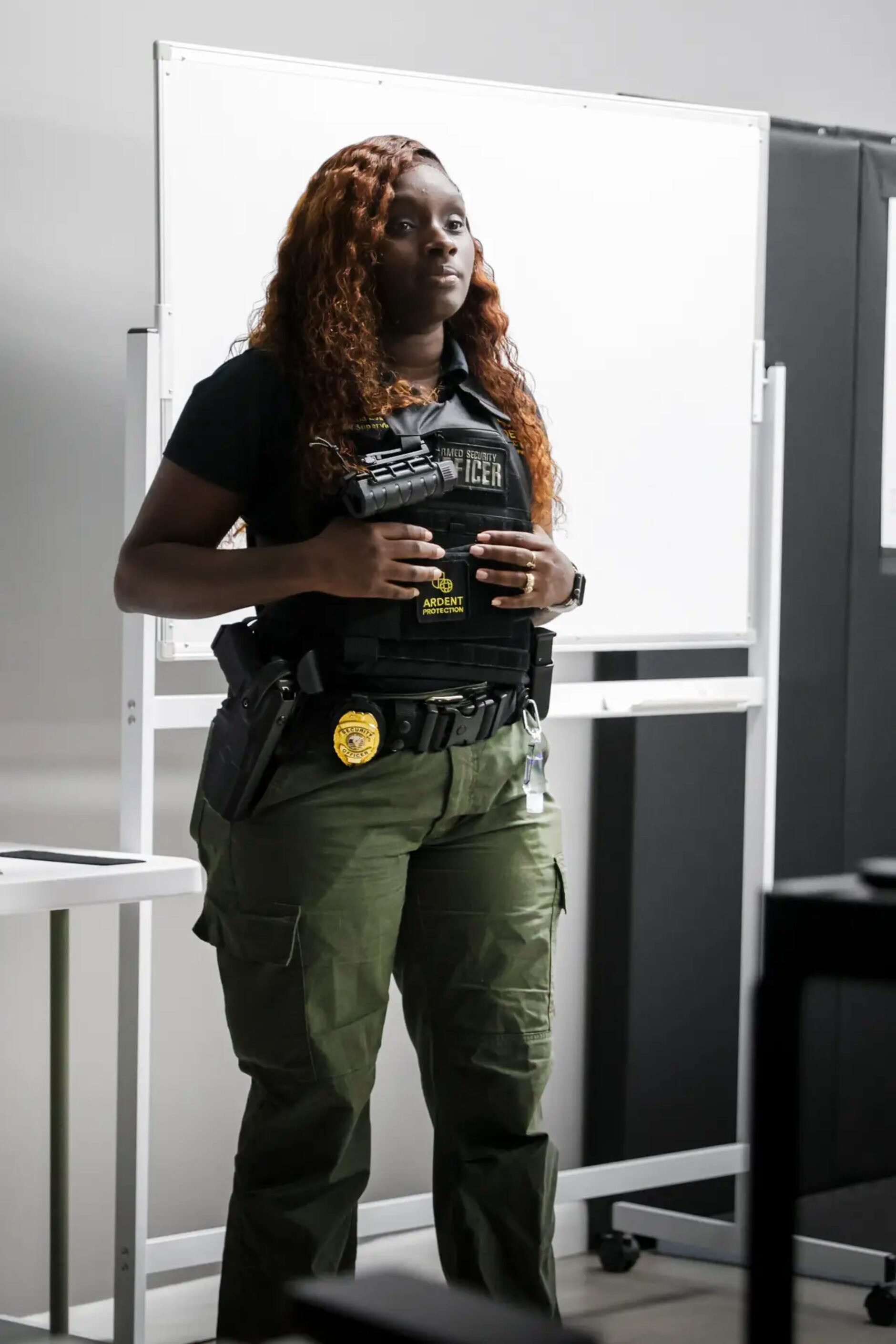
Nothing Happens.
That's the Entire Job.
A fire watch shift is eight or twelve hours in which, on almost every single night, nothing happens at all. That is what makes it hard. The failure mode isn't panic, it's drift, and drift is invisible right up until the one night it isn't.
Brief in, then walk it
The Officer arrives knowing what's impaired, which areas it affects, whether the building is occupied, and what the fire official has already said. Then they walk the affected area on foot. Not a lap of the parking lot. The stairwells, the mechanical spaces, the floors.
Around, and around, and around
Continuous patrol. Every round is a fresh look, not a re-run of the last one. And they're not only looking for smoke. Blocked egress, propped fire doors, a stacked pallet in a stairwell, anything that would matter if this turned into the night it turns into.
Write it down while it's still true
Times, areas, conditions, hazards, actions, notifications. Written as it happens, never reconstructed at 6 a.m. from memory. A log written at the end of a shift is not a record, it's a recollection.
Hand it over, properly
The next Officer needs to know what changed overnight, what the technician said, and what to keep an eye on. A handoff that's just "all quiet" is how a hazard survives three shifts.
That's the same shape on every job. What changes is what the building has actually lost.
What's Broken Decides
What the Officer Is There to Do.
Providers who treat every impairment identically are telling you they haven't thought about it. A panel outage and a fire pump outage put an Officer in two genuinely different roles, and they run on two genuinely different clocks.
| Impairment | Typical duration | What's lost | The Officer's role |
|---|---|---|---|
| Fire alarm | 2 to 6 days | The primary notification system | The Officer becomes the notification system |
| Sprinkler | 1 to 3 weeks | Automatic suppression | Extreme vigilance, and getting ignition sources out of the area |
| Fire pump | 2 to 6 weeks | Water pressure for suppression | As above, over a much longer exposure |
| Fire panel | 2 to 8 weeks | Central control, monitoring, sometimes fire department notification | The Officer becomes the link to the fire department |
| Combination, or new construction | Varies | Multiple systems, or none of them yet | Combined duties, plus live construction hazards |
Durations are typical, not promised. Your fire official has the final word on what coverage your building needs, and we confirm the requirement with them before the first shift.
Two to eight weeks is a long time to keep somebody genuinely alert. Which is the real question behind all of this: what keeps attention from decaying?
Attention Doesn't Decay
Because People Are Lazy.
It decays because a standard nobody tests will drift. That's true of any standard, in any company, ours included. So the answer isn't a lecture about vigilance. It's three unglamorous mechanisms.
Nothing else on the plate
The moment an Officer has a second duty, the watch becomes the thing that gets interrupted. No other responsibilities is not a formality. It's the mechanism.
Somebody comes out and looks
Scheduled visits, and unannounced ones. A patrol gets shortened on a quiet Tuesday because that door is always locked anyway. That's how erosion starts, and a site check is what catches it while the fix is still small.
The log is read by someone
A log nobody ever reads becomes a page of "all clear" within a week. Ours are submitted to the Fire Marshal, which is a very effective way of making sure they say something true.
Every ARDENT Officer completes 16 hours of ARDENT training on top of Florida's required 40-hour Class D certification, before they ever stand a post. The license makes someone legally eligible to work. The training is what makes them useful at 3 a.m.
The Signs That Nobody
Is Really Watching.
You won't be on site at 3 a.m., so you can't watch the watch. What you can do is listen to how a provider talks about it, and look at what they hand you afterwards.
The provider who says none of those things is worth keeping. What they should be handing you instead is very specific.
The Boring Detail
Is the Whole Proof.
There is nothing clever in any of this. It's just the list of things that either happen or don't, and a client can check almost all of it without leaving their desk.
Our reporting standard: clear, concise, complete, accurate
Complete means who, what, where, when, why and how. Accurate means factual, with no assumptions and no guessing at motive. Officers are trained that "Fire, Flood, or Blood" means notify immediately, and that when in doubt, you write the report. A report written to make us look good is worthless to you, so we don't allow them.
Speed matters too, and everyone in this industry sells it. It's worth being precise about what speed is actually worth.
What People Ask
Before the First Shift.
How fast can you actually get an Officer here?
Our standard Fire Watch setup is four hours. Our fastest is under 60 minutes, and we've done that more than once. Fast response creates control. Rushed response creates confusion. A company that arrives in 90 minutes and performs badly can create more risk than one that takes a little longer and starts correctly. Showing up fast is half the job. Starting properly is the half that protects the site. Be careful with any provider who promises an exact arrival time before they know anything about your building.
Can I see the log while the watch is running?
Yes, and it's a fair thing to ask of anyone. The log is the deliverable. If a provider can't show you a log mid-impairment, or shows you one that's a page of identical entries, you've learned something important without having to wait for an inspection to learn it.
Does the Officer need any particular license for fire watch?
In Florida, security work is licensed under Chapter 493 and issued through FDACS. Unarmed Officers hold a Class D, which follows a 40-hour state-approved course. Beyond the license, the fire watch standard calls for someone trained in fire prevention and in how to notify the fire department, which is a training question rather than a licensing one. It's worth asking a provider to describe that training rather than just confirming the license. How Florida security licensing works covers the classes in plain English.
What does fire watch cost in Florida?
Commonly $35 to $55 an hour, depending on the property, the hours and how many Officers the impairment calls for. Be careful below $25. At that rate the math only works if the person is untrained, unsupervised, or doing something other than the watch, and any one of those three is what gets a property found non-compliant.
All of that is checkable before you sign anything. Which is more than most people are ever offered.
Written by the People
Who Walk the Building.
ARDENT Protection
A Florida security and protection company, licensed since 2020 (Florida Security Agency License #B1900411). We run Guard Services, Fire Watch, Event Security, Executive Protection and Workplace Violence Prevention across the state. More than 70,000 hours of Fire Watch delivered since 2020, and a log filed for every one of them. Questions about anything here go to (954) 787-3700, and a person answers.
Fire Watch Requirements in Florida, Explained
The thresholds, the six things a watch has to be, and the counting rule that catches most properties out.
Read itWhat It Costs to Skip Fire Watch During an Outage
A watch that looked like coverage and wasn't, and the $388,800 correction that followed it.
Read itWho Actually Checks On Your Security Officer?
The mechanism that stops any standard from drifting, on a fire watch or anywhere else.
Read itIf a system on your property is down tonight, the fastest thing you can do is pick up the phone. Call somebody. It doesn't have to be us.
Tell Us What's Impaired.
What's down, whether the building is occupied, and what your fire official has said so far. We'll tell you straight what the coverage actually needs to be, including when that's less than you were quoted. Standard setup is four hours. Or call (954) 787-3700 and someone will pick up.